


Parshat Acharei Mot–Kedoshim: More Than This Moment

Why Return Begins with Remembering Who You Are
Introduction — Before Return, There Must Be Dignity
Last week, in Tazria–Metzora, we explored the danger of defining a person by a single moment. The Torah’s process surrounding צרעת teaches that even when separation is necessary, a person is never meant to be reduced to one failure, one mistake, or one visible סימן. It is not a final judgment, but part of reflection, reassessment, and the possibility of return.
That idea is true not only in how we are meant to look at others, but also in how we look at ourselves.
One of the hardest parts of failure is often not the mistake itself, but the identity that begins to form around it. A person says something they regret, damages trust, loses direction, or reaches a place of spiritual and emotional distance. At first, the struggle feels practical: how do I fix what went wrong? But over time, the question becomes deeper: Is this simply who I am now?
This is where healing becomes difficult. When a person begins to see themselves through the lens of their worst moments, teshuvah becomes much harder. Shame convinces them that the problem is not only what they did, but who they are. Instead of feeling capable of return, they begin to feel defined by failure. Once failure becomes identity, repair feels dishonest, because a person is no longer trying to return—they are trying to become someone else.
But Torah does not see people that way. Failure may require accountability, reflection, and change, but it does not erase identity. A mistake is real, but it is not the whole story. A person is always larger than the moment they are standing in.
Before teshuvah, before holiness, and before rebuilding what was broken, there must first be dignity. A person must believe that beneath disappointment, distance, and regret, something essential remains intact. Without that belief, return becomes almost impossible.
Real growth does not begin with perfection. It begins with the willingness to believe that failure is not final, that something whole still remains beneath the damage, and that we are always more than the worst thing we have done.
Section I — Acharei Mot: Growth Begins After Failure
The opening of Parshat Acharei Mot is striking because it begins by returning us to pain. The Torah introduces the parsha with the words, וַיְדַבֵּר ה׳ אֶל מֹשֶׁה אַחֲרֵי מוֹת שְׁנֵי בְנֵי אַהֲרֹן, reminding us that everything that follows emerges in the aftermath of loss. Before the avodah of Yom Kippur, before the instructions for entering the Kodesh HaKodashim, and before the Torah outlines the path toward holiness, it places us back in the shadow of the death of Nadav and Avihu.
This is not simply a narrative reminder. It is part of the teaching itself.
Rashi explains that the warning given to Aharon about entering the Holy of Holies is framed through this tragedy. The lesson is not presented in abstraction, but through lived pain. The memory of what happened becomes the context for what must come next. The Torah could have begun with the laws alone, but instead it insists that we begin here, because spiritual life does not develop apart from failure and loss. It develops through them.
There is a natural tendency to imagine growth as something that begins when life is stable and a person feels clear, strong, and spiritually aligned. We assume holiness begins from confidence. But the Torah presents a different model. Very often, the deepest growth begins when certainty breaks—after disappointment, consequences, and the moment a person is forced to confront what they would rather avoid.
The Nesivot Shalom writes that moments of brokenness can become moments of unusual honesty. As long as a person feels in control, they can live inside assumptions about themselves that may not be true. But when something breaks—when pride is shaken, plans fail, and pain enters—the illusions begin to fall away. What remains may feel uncomfortable, but it is often the first place where real truth can emerge.
Failure can do one of two things. It can cause a person to collapse inward and define themselves by what went wrong, or it can force them to confront themselves more honestly. The pain itself does not determine the outcome. What matters is whether a person remains trapped in the failure or allows it to become the beginning of deeper self-understanding.
Acharei Mot teaches that holiness does not begin before the break. It begins after it. The question is not whether a person has failed, but whether they can still believe there is something within them worth rebuilding.
Section II — The Kodesh HaKodashim: The Inner Self Remains Intact
After the Torah reminds us of the loss of Nadav and Avihu, it turns immediately to the avodah of Yom Kippur and to the most sacred moment of the year: the entry of the Kohen Gadol into the Kodesh HaKodashim. The Torah says, בְּזֹאת יָבֹא אַהֲרֹן אֶל הַקֹּדֶשׁ — “With this shall Aharon come into the holy place.” Access to the Holy of Holies is not casual. It requires preparation, humility, and deep awareness of where one is entering.
The lesson is not only about ritual precision. It teaches that holiness requires reverence. One cannot approach the deepest places carelessly.
The Sfat Emet explains that the Mishkan is also a map of the human being. Just as there is an outer courtyard, an inner chamber, and a hidden Holy of Holies, so too every person has layers. There is the outer self that others see—behavior, words, reactions, and choices. But beneath that is an inner point, untouched by the noise of the outside world, where the deepest truth of the person remains.
This becomes especially important after failure, because failure pulls a person toward the surface. People begin to define themselves by what is most visible: the mistake, the poor decision, the damage caused, the relationship strained. They look at what is broken and begin to believe that it is the whole story.
The Aish Kodesh writes that even when the external vessel is shattered, the נקודה פנימית, the innermost point of the soul, remains whole. A person may feel spiritually broken, but the core of the soul is not destroyed. The Divine presence within a person does not disappear because they have fallen. It may be hidden, but it is still there.
Teshuvah does not mean pretending the damage is not real. It demands honesty. But honesty must include more than the mistake. If a person believes they are nothing more than their failure, change feels almost impossible, because they are trying to become someone else. But if they understand that failure affects behavior without erasing the soul itself, return becomes something very different: not the attempt to create a new identity, but the process of returning to who they already are beneath the damage.
The Kodesh HaKodashim teaches that the holiest point is often the most hidden. Real repair begins when a person stops identifying only with what is broken and remembers that something deeper remains intact.
Section III — Kedoshim Tihiyu: Holiness Is Still Expected
After Parshat Acharei Mot, with its focus on loss, restraint, and the careful process of return, the Torah moves into Parshat Kedoshim with a direct and demanding call: קְדֹשִׁים תִּהְיוּ, כִּי קָדוֹשׁ אֲנִי ה׳ אֱלֹקֵיכֶם — “You shall be holy, for I, Hashem your God, am holy.”
The placement of this command is significant. The Torah does not wait for perfect conditions before speaking about holiness. It comes after tragedy, after warning, and after confronting human failure. One might have expected the Torah to lower its expectations and speak only about caution or survival. Instead, it does the opposite. It still says: you are called to holiness.
This teaches something essential. Kedushah is not reserved for people who have never struggled, nor is it a reward for perfection. It is the expectation placed upon every person, even after disappointment and failure. The Torah does not define a person by what has gone wrong. It continues to speak to who they are still responsible to become.
This is the next step after remembering that the inner self remains intact. It is not enough to know that the soul is still there. A person must also be willing to live in a way that reflects it. Inner dignity is the foundation, but kedushah is the responsibility that grows from it.
The Sforno explains that holiness does not mean withdrawing from life or separating from the world. It means living בתוך החיים, with moral clarity and responsibility inside ordinary human relationships. Kedushah is not found in escape, but in how a person speaks, chooses, restrains themselves, and responds to others within real life.
Rav Hirsch adds that holiness means refusing to let the immediate define the whole self. Circumstances may shape experience, but they do not determine essence. A person can be surrounded by failure and still not be reduced to it. Holiness begins when a person remembers that they answer to something deeper than the moment in front of them.
This is why the Torah does not say: become someone else. It says: קְדֹשִׁים תִּהְיוּ. Be holy. Return to the person you are meant to be.
Kedushah is not perfection. It is the decision to live in alignment with the deeper truth of who a person is. Once a person remembers that the soul remains intact, the next step is not comfort, but responsibility. Holiness is still expected, and still possible, even after everything that came before.
Section IV — Ve’Ahavta: Love Begins with Recognizing Human Worth
At the center of Parshat Kedoshim stands one of the most familiar and demanding mitzvot in the Torah: וְאָהַבְתָּ לְרֵעֲךָ כָּמוֹךָ — “Love your fellow as yourself.” Rabbi Akiva calls it a כלל גדול בתורה, one of the great principles upon which so much of Torah life depends.
It is often understood simply as a call to kindness: treat others the way you would want to be treated. That is true, but the mitzvah asks for something deeper.
It requires a person to ask an honest question: what do I need when I am struggling?
When I feel ashamed, what helps me stand up again? When I feel distant, what helps me believe I can return? What do I need most in moments of failure—patience, compassion, understanding, trust, someone who sees beyond the mistake?
Most people know that answer immediately, because most of us remember exactly what it feels like to need mercy and not know how to ask for it. We know what it feels like to want someone to slow down, to listen before judging, to believe in us before demanding change. We know how deeply we need empathy before correction, dignity before accountability, and love before advice.
The deeper meaning of וְאָהַבְתָּ לְרֵעֲךָ כָּמוֹךָ is taking that awareness and turning it outward.
If I know how much I need compassion, I must learn to offer compassion. If I know how much I need someone to believe that I am more than my worst moment, I must become that person for someone else. If I know how deeply I need patience when I am trying to rebuild, I cannot deny that patience to the people around me.
This mitzvah is not simply about kindness. It is about using our own vulnerability as a guide for how to love.
The Baal Shem Tov teaches that often the way a person heals is not only by searching inward, but by becoming a source of life for another. Sometimes the kindness we struggle to give ourselves becomes easier to access when we offer it outward first. In giving dignity, we often recover our own.
Love is not emotional warmth alone. It is the refusal to reduce another person to the moment they are standing in. It is the willingness to say: I know what it feels like to need mercy here, and because of that, I will not deny it to you.
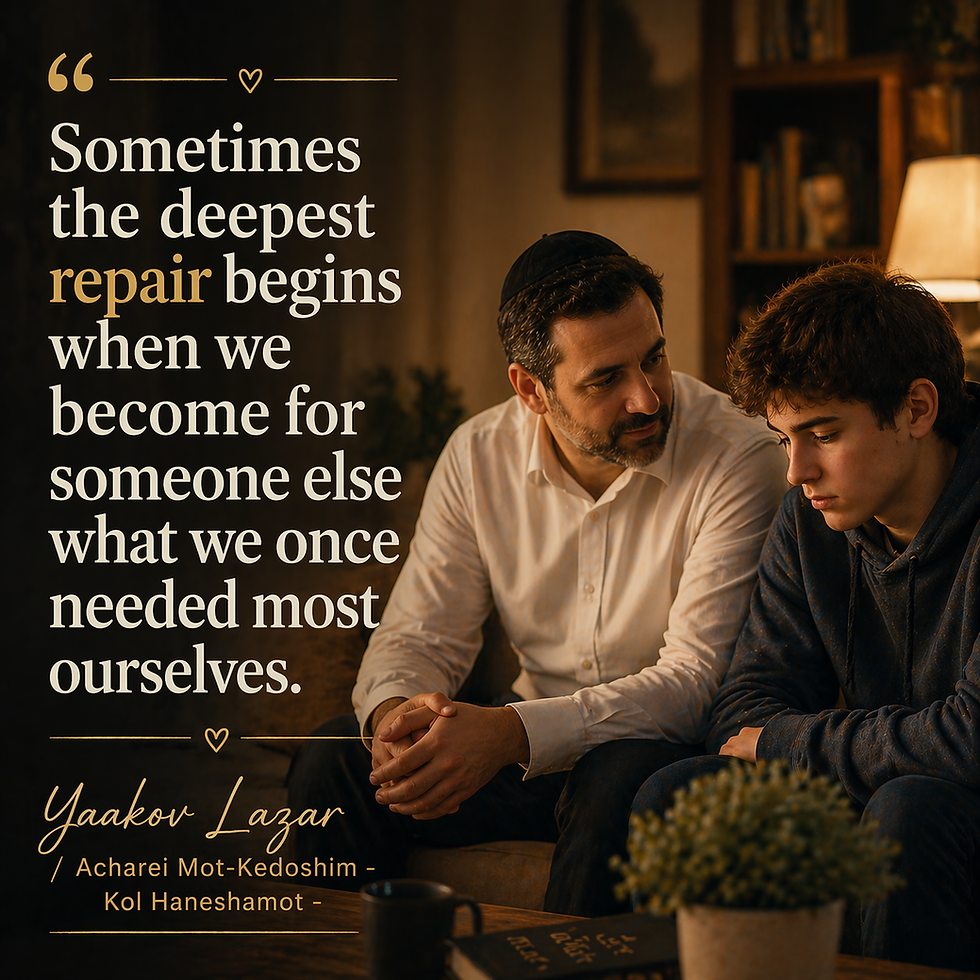
Sometimes the deepest repair begins there—not in fixing ourselves directly, but in learning how to become for someone else what we ourselves once needed most.
Section V — Lo Tisna: Shame Grows in Silence
Immediately after commanding love, the Torah adds another instruction that is just as important and often more difficult: לֹא תִשְׂנָא אֶת אָחִיךָ בִּלְבָבֶךָ — “Do not hate your brother in your heart.” The Torah is not only warning against open conflict or visible anger. It is addressing what happens when pain is carried silently, when resentment, hurt, and shame remain hidden beneath the surface.
Silence often creates more damage than confrontation. Open conflict can at least be addressed, but what remains buried in the heart begins to shape a person from within. Unspoken disappointment turns into distance, hidden resentment becomes disconnection, and shame grows strongest in places where it cannot be named.
This is the natural danger that follows Section IV. When a person does not receive the empathy, patience, or understanding they need, pain turns inward. Instead of being processed, it becomes private. Instead of asking for help, they carry it alone. What begins as hurt slowly becomes shame.
The Aish Kodesh writes that concealed pain creates a kind of inner exile. When suffering remains trapped inside, a person becomes separated not only from others, but from themselves. What cannot be spoken cannot be healed. Silence can protect dignity, but it can also become the place where dignity slowly disappears.
The Torah pushes against that silence. It refuses to let hatred remain hidden in the heart, because what stays hidden too long begins to define a person. Healing requires movement from concealment to honest recognition.
The Torah is not calling for humiliation, but for honesty that protects dignity. Real healing begins when truth can be spoken safely—when a person can say, “This is where I am,” without fear that the confession itself will become another wound. Shame loses much of its power when it is met with compassion instead of rejection.
Repair becomes possible when silence is no longer carrying the entire weight alone.
Section VI — Tochacha: Correction Must Protect Dignity
Parshat Kedoshim does not stop with love or with the warning against silent resentment. It goes one step further and addresses one of the most difficult parts of any relationship: the need to confront what is wrong. The Torah commands, הוֹכֵחַ תּוֹכִיחַ אֶת עֲמִיתֶךָ — “You shall surely rebuke your fellow,” but it immediately adds, וְלֹא תִשָּׂא עָלָיו חֵטְא — “and do not bear sin because of him.”
These two ideas must be read together. The Torah does not support silence in the face of harmful behavior, but it is equally clear that correction itself can become destructive if it is handled without care. Rebuke is necessary, but the way it is given matters just as much as the content of what is said.
Section V taught that healing begins when pain can be spoken honestly. Section VI adds that honesty alone is not enough. The way truth is delivered determines whether it becomes a path to repair or another source of shame.
The Ramban explains that the warning of וְלֹא תִשָּׂא עָלָיו חֵטְא teaches that correction must never become humiliation. The goal of תוכחה is not to punish, embarrass, or assert moral superiority. Its purpose is restoration. It is meant to preserve relationship, not destroy it.
This is a difficult balance because people often confuse correction with control. When emotions are high, rebuke can easily become frustration instead of responsibility. A person may speak the truth, but if that truth is delivered in a way that strips dignity, it often creates defensiveness instead of change.
The Lubavitcher Rebbe emphasized that words of truth can only be received where love is already felt. A person can hear difficult things when they know they are still respected, still valued, and still seen as more than the problem being addressed. Without that foundation, even accurate criticism can feel like rejection.
Correction without dignity deepens shame. Instead of helping a person return, it confirms their fear that they are defined by failure. Correction with dignity creates something entirely different. It allows a person to face what must change without feeling that they themselves have been erased.
People rarely grow because they were made to feel small. Real change happens when someone feels they are still larger than their worst mistake. When rebuke communicates not “this is who you are,” but “this is not all of who you are,” it opens the door to return.
That is the Torah’s model of correction—not punishment, but responsibility rooted in love. Not humiliation, but the belief that a person is still capable of becoming more.
Parenting Reflection
This applies directly to parenting, especially when a child is struggling and the relationship begins to feel strained. Parents naturally focus first on behavior—the choices being made, the distance that is growing, the conflict in the home, and the fear of where things may be heading. The urgency of the situation can make everything feel like it needs to be fixed immediately.
But underneath the behavior is often a deeper question that matters even more: does this child still feel worthy of love?
A child carrying shame often does not experience correction as guidance. They experience it as confirmation of what they already fear—that they are disappointing, difficult, or no longer fully wanted. When that happens, stronger control rarely creates real change. It usually deepens the distance.
Very often, what a struggling child needs most is exactly what we described in Section IV: patience before pressure, empathy before advice, and relationship before correction. They need someone who can see beyond the behavior and remember the person underneath it. They need to feel that even when they are difficult to reach, they have not become difficult to love.
Before a child can return, they need to believe they are still someone worth returning to.
This does not mean removing boundaries or avoiding accountability. Children need limits, structure, and honesty. But those things must be built on something deeper: dignity. A child has to feel that their struggles do not define them, that their mistakes are real but not final, and that love has not become conditional.
Often, the most important work of a parent is not fixing behavior, but protecting dignity—helping a child feel: you are still good, you are still wanted, you are still worth fighting for. I see what is happening, and I still see you beneath it.
Sometimes the greatest act of parenting is holding belief for a child until they are able to hold it for themselves—staying steady when they cannot, refusing to let their worst moment become their permanent identity.
That is where real repair begins—not with control, but with the quiet and consistent message that failure is not the end of the relationship, and it is not the end of who they are.
Closing — Return Begins with Remembering Who You Are
Parshat Acharei Mot begins in the aftermath of loss. Parshat Kedoshim responds with a call to holiness. Together, they teach that growth does not begin from perfection, but from the difficult work of rebuilding after something has already gone wrong.
This is one of the Torah’s deepest lessons. Before a person can return to Hashem, they often need to return to themselves.
Before change, there must be dignity. Before repair, there must be the belief that failure is not identity. A person who sees themselves only through the lens of their mistakes will struggle to believe that teshuvah is possible. Shame convinces them that they are not someone who has failed, but someone who is failure. From that place, return feels dishonest rather than hopeful.
But the Torah insists otherwise.
It does not ask a person to become perfect before approaching holiness. It asks them to remember that beneath disappointment, regret, and the visible consequences of their choices, the soul itself remains intact. The deepest part of a person is not erased by their lowest moment.
And sometimes, the way a person remembers that is through love—through someone who offers the patience they needed, the compassion they could not find for themselves, and the belief that they are still more than the moment they are standing in. Sometimes the deepest repair begins when we become for someone else what we once needed most ourselves, or when someone else refuses to let us be reduced to our failure.
This is true in our relationship with Hashem, in the way we look at others, and in the way we raise our children. Real growth begins when we stop defining ourselves and those we love by a single moment and begin to believe again in the possibility of return.
Holiness is not the absence of failure, but the refusal to let failure have the final word. It is the willingness to say: this moment is real, but it is not all of me. I am still more than what happened here. I am still capable of return. And because of that, the story is still being written.
Have a Wonderful Shabbos!!!
Yaakov Lazar


Comments